WhatsApp Drip Campaigns: Automated Follow-Up Sequences That Convert (2026)
Learn how a WhatsApp drip campaign works, why automated follow-up sequences beat one-off blasts, and get 5 ready-to-use drip flows with day-by-day plans.
Key Takeaways
- A WhatsApp drip campaign is an automated sequence of follow-up messages sent over days or weeks, triggered by a customer action like signing up or abandoning a cart.
- Drip sequences outperform one-off blasts because they reach customers at the right moment with the right context, lifting conversions through timing and relevance.
- Every sequence has four parts — a trigger, timing/delay, the message, and a goal — and you can branch on whether the customer replied or converted.
- Five proven sequences cover the customer lifecycle: new-signup welcome, lead nurture, abandoned cart, post-purchase, and win-back.
- Session messages in the 24-hour window cost only PayPerWA ₹0.20; business-initiated template messages add Meta's rate (e.g. Marketing ₹0.86 + PayPerWA ₹0.20 = ₹1.06).
What Is a WhatsApp Drip Campaign?
A WhatsApp drip campaign is an automated series of follow-up messages sent to a contact over a set period, triggered by an action they take rather than blasted all at once. The name comes from drip irrigation — water (or in this case, messages) delivered steadily over time instead of in one flood.
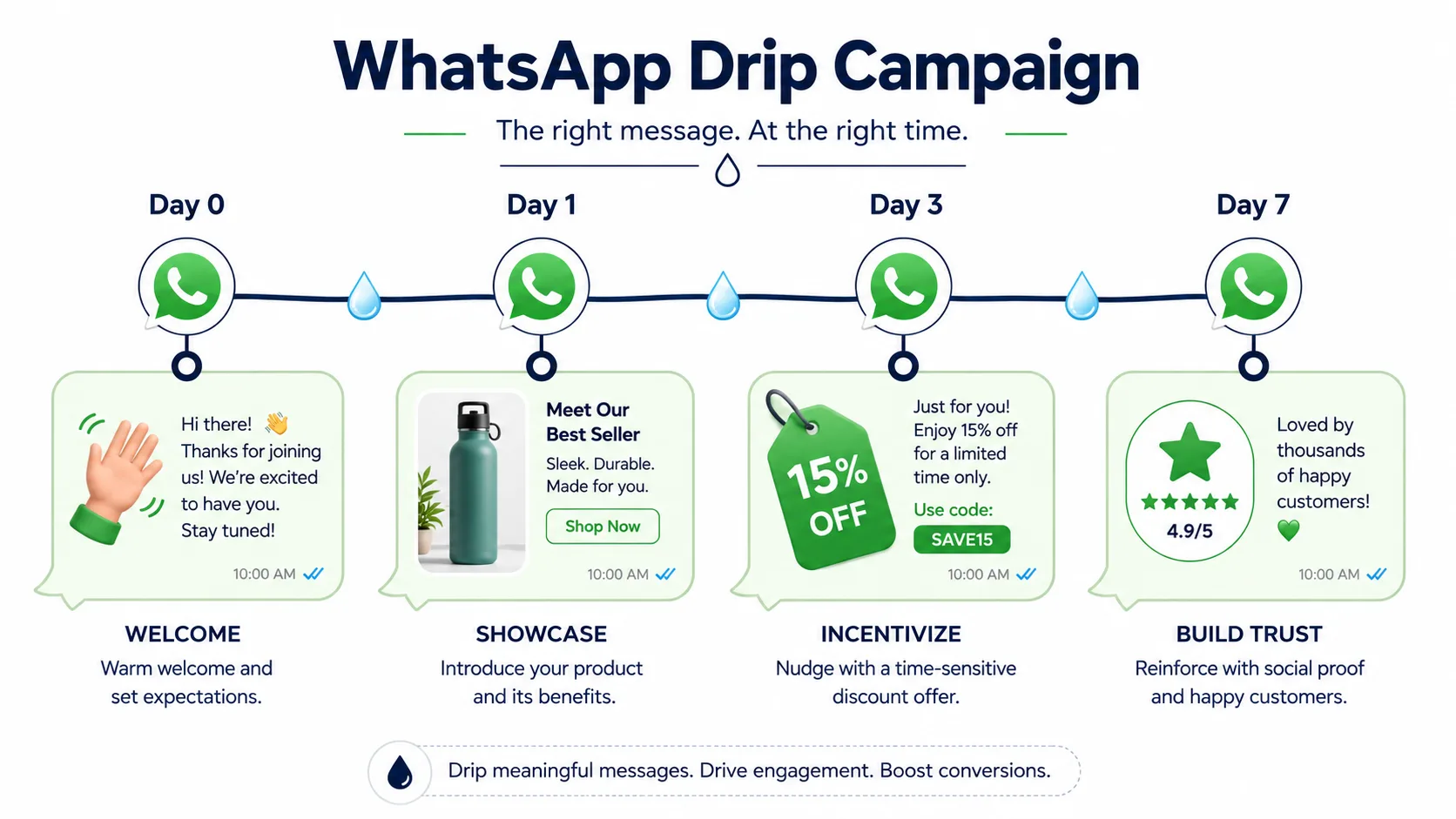
A simple example: a customer signs up on your store. Day 0 they get a welcome message, Day 1 they get a how-it-works tip, Day 3 they get a first-order discount, and Day 7 they get a gentle nudge if they have not bought yet. Each message is pre-written and scheduled once; the automation handles the rest for every new signup forever.
Drips are the backbone of WhatsApp marketing automation. Instead of remembering to follow up manually, you build the sequence once and it runs on autopilot for thousands of contacts.
Why Drip Campaigns Beat One-Off Blasts
Drip campaigns beat one-off blasts because they reach each customer at the right moment with relevant context, which lifts conversions far more than a single mass message. A blast treats everyone the same; a drip responds to where each person is in their journey.
Here is why sequences win:
- Timing matches intent. An abandoned-cart reminder sent one hour after the customer left converts dramatically better than a generic offer sent randomly.
- Repetition without nagging. Most sales need multiple touches. A drip spreads three or four gentle reminders over a week instead of one ignored message.
- Personal relevance. Each step in the sequence speaks to a specific stage — welcome, education, offer, urgency — so the message always feels apt.
- Set once, run forever. You build the flow a single time and it works for every new contact automatically, freeing your team entirely.
- Higher lifetime value. Post-purchase and win-back drips bring customers back, raising repeat-purchase rates that one-off campaigns never touch.
For e-commerce in particular, structured sequences are what turn first-time buyers into repeat customers — see our WhatsApp marketing for e-commerce playbook.
The Anatomy of a Drip Sequence
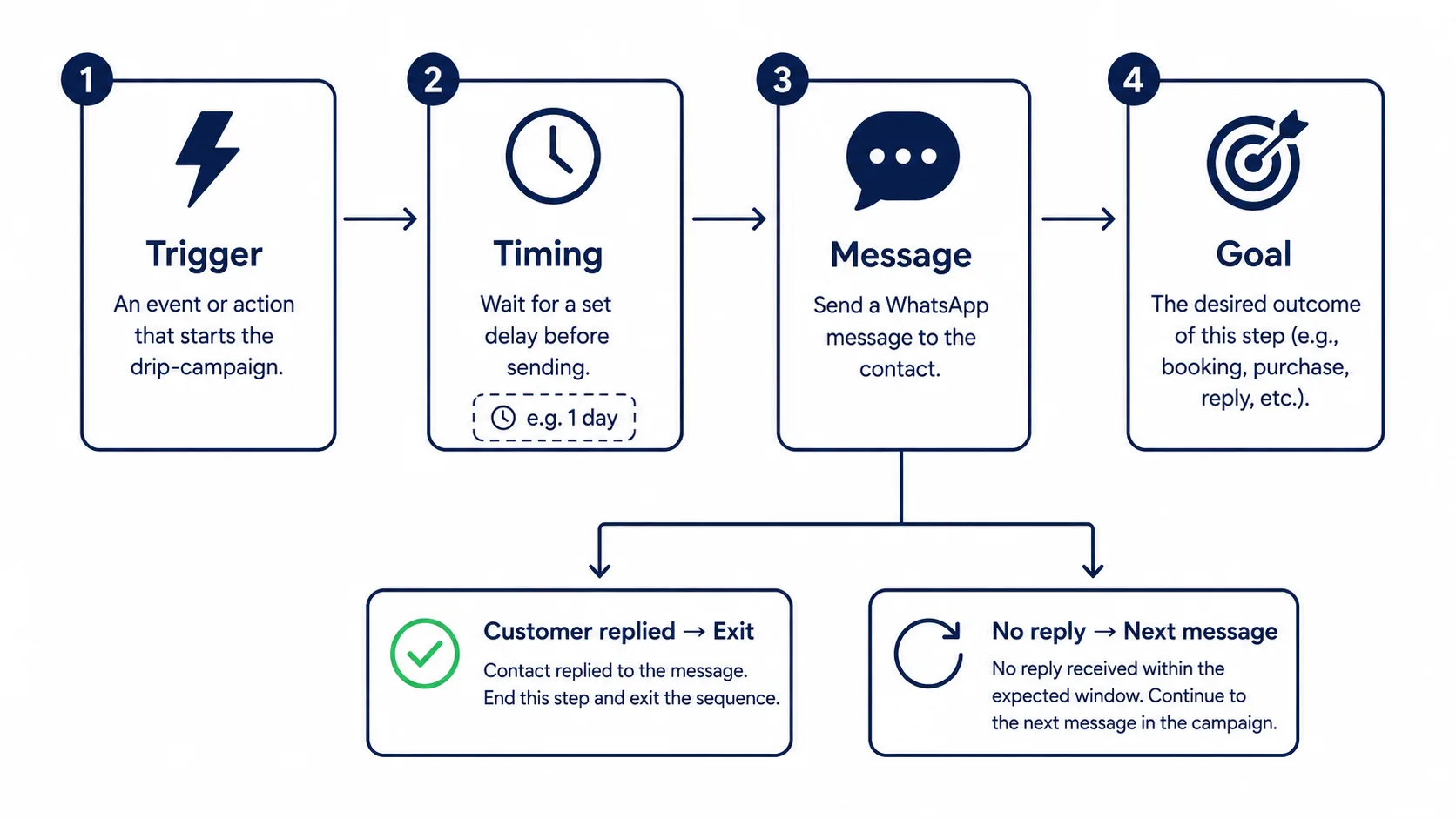
Every drip sequence is built from four parts: a trigger, timing, a message, and a goal. Get these four right for each step and the whole sequence works.
- Trigger. The event that starts the sequence — a new signup, a cart abandonment, a completed purchase, or a period of inactivity. This is the entry point.
- Timing / delay. How long to wait before each message. Day 0 (immediate), Day 1, Day 3, Day 7 are common spacings. Too fast feels pushy; too slow loses momentum.
- Message. The actual content — a welcome note, a tip, an offer, or a reminder. Decide whether it is a session message (inside the 24-hour window) or a business-initiated template, because that drives the cost.
- Goal. What this step should achieve — open the relationship, educate, convert, or re-engage. Define the goal and you can measure success.
Advanced drips also branch: if the customer replies or buys, they exit the sequence (so you never nag a paying customer); if they do not, they continue to the next nudge. Branching is what separates a smart sequence from a dumb timer. You can build this logic visually with WhatsApp Flows.
5 Ready-to-Use Drip Sequences
These five sequences cover the entire customer lifecycle, from first signup to winning back a lapsed buyer. Use them as templates and adapt the copy to your business.
1. New-Signup Welcome Series
Trigger: contact signs up or opts in.
- Day 0 — Welcome and brand intro (who you are, what to expect).
- Day 1 — Show your best products or services.
- Day 3 — First-purchase incentive (e.g. 10% off code).
- Day 7 — Social proof + gentle nudge to act.
2. Lead-Nurture Sequence
Trigger: lead enquires but does not buy.
- Day 0 — Thank you + answer their likely question.
- Day 2 — Address a common objection (price, quality, trust).
- Day 4 — Customer testimonial or case study.
- Day 7 — Limited-time offer to create urgency.
3. Abandoned-Cart Recovery
Trigger: customer adds to cart but does not check out.
- 1 hour — Gentle reminder with the cart items.
- Day 1 — Help offer (any questions? COD available).
- Day 2 — Small discount or free-shipping nudge.
This is the highest-ROI drip for online stores — read the full playbook on abandoned-cart recovery.
4. Post-Purchase Sequence
Trigger: order placed.
- Day 0 — Order confirmation (utility template).
- Day 2 — Delivery / shipping update.
- Day 5 — How-to-use tips or care instructions.
- Day 10 — Review request + reorder invitation.
5. Win-Back Sequence
Trigger: no purchase for 60-90 days.
- Day 0 — We miss you message.
- Day 3 — What is new since they last shopped.
- Day 7 — Comeback offer with a deadline.
For service businesses, an appointment-style nurture works similarly — see appointment reminder automation and our clinics guide.
Day-by-Day Plan: New-Signup Welcome Series
This table lays out the new-signup welcome series day by day, including the message goal, the message type, and the exact cost per contact. Use it as your build checklist.
| Day | Message | Goal | Type | Cost per Contact |
|---|---|---|---|---|
| Day 0 | Welcome + brand intro | Open the relationship | Marketing template | Meta ₹0.86 + PayPerWA ₹0.20 = ₹1.06 |
| Day 1 | Show best products | Educate | Marketing template | Meta ₹0.86 + PayPerWA ₹0.20 = ₹1.06 |
| Day 3 | First-order discount code | Convert | Marketing template | Meta ₹0.86 + PayPerWA ₹0.20 = ₹1.06 |
| Day 7 | Social proof + nudge | Convert / urgency | Marketing template | Meta ₹0.86 + PayPerWA ₹0.20 = ₹1.06 |
Total for a contact who never replies: about ₹4.24 across four touches. The moment a customer replies, the 24-hour window opens and any further messages in that window cost only PayPerWA ₹0.20 — Meta charges nothing. That is why drips that spark a conversation get cheaper as they progress.
How to Build a Drip Campaign on PayPerWA
You build a drip campaign on PayPerWA by creating the templates, defining the trigger, then arranging the timed steps in the flow builder. Here is the workflow:
- Create and approve your templates. Each business-initiated step needs a Meta-approved template. Submit them first; utility templates approve in minutes, marketing in up to 24 hours.
- Choose the trigger. Set what starts the sequence — a new contact tag, a signup event, a cart-abandon event, or an inactivity window.
- Add timed steps. For each step, set the delay (1 hour, 1 day, 3 days) and attach the message.
- Add branching. Configure exit conditions so contacts who reply or convert leave the sequence and do not get nagged.
- Set the opt-out. Ensure every marketing step carries an opt-out path and STOP is honoured.
- Activate and monitor. Turn the drip on; new contacts enter automatically. Watch delivery, read, and reply rates in analytics.
The flow builder is no-code and visual. For the full builder walkthrough, see how to build a WhatsApp chatbot without coding and the features overview.
Template vs Session Messages and What They Cost
The cost of a drip depends on whether each message is a session message in the 24-hour window or a business-initiated template. This is the single most important thing to plan around.
- Session messages are replies sent within 24 hours of the customer's last message. Meta charges nothing; you pay only PayPerWA ₹0.20 per message.
- Business-initiated templates are messages you send to start or continue a conversation outside the window. Meta's rate applies on top of the platform fee.
| Message Type | Meta Fee | PayPerWA Fee | Total |
|---|---|---|---|
| Session message (in 24h window) | ₹0.00 | ₹0.20 | ₹0.20 |
| Marketing template | ₹0.86 | ₹0.20 | ₹1.06 |
| Utility template (order / delivery update) | ₹0.13 | ₹0.20 | ₹0.33 |
| Authentication template (OTP) | ₹0.13 | ₹0.20 | ₹0.33 |
Pro tip: design drips so early steps invite a reply. Once the customer responds, the rest of your sequence runs as free-from-Meta session messages at just ₹0.20 each. Automated and flow messages are always billed the ₹0.20 platform fee; the Meta charge only ever applies to business-initiated templates. PayPerWA is prepaid with no subscription — see pricing — and the wallet balance gate pauses the drip if your balance runs out, so there are never surprise bills.
Measuring and Optimizing Your Sequences
Optimize a drip by tracking delivery, read, reply, and conversion rates at each step, then fixing the weakest step first. A sequence is only as strong as its drop-off points.
Track these metrics per step:
- Delivery rate — are messages reaching phones? Low delivery points to bad numbers or quality flags.
- Read rate — are people opening them? On WhatsApp this is usually 90%+; a low read rate signals a bad send time or weak first line.
- Reply rate — are messages sparking conversation? Higher replies mean cheaper later steps and warmer leads.
- Conversion rate — the step that actually drives the goal (purchase, booking, review).
To optimize: A/B test the offer step (discount amount, urgency wording), adjust timing (try Day 2 instead of Day 3), and shorten any sequence where a late step underperforms. Watch for unsubscribe spikes — they signal you are messaging too often. Use the proven template examples as a starting point for higher-converting copy.
Compliance and Opt-Out
Every WhatsApp drip campaign must run only to contacts who opted in, and every marketing message must offer a clear way to opt out. This is non-negotiable under both Meta's policy and Indian practice.
- Get explicit opt-in first. Only enrol contacts who agreed to receive WhatsApp messages from you — a checkbox at signup, a keyword opt-in, or a clear consent point.
- Honour STOP instantly. A contact who replies STOP must be removed from all sequences immediately. PayPerWA never messages an opted-out contact.
- Keep frequency sane. Too many messages trigger blocks and reports, which lower your Meta quality rating and can restrict your number.
- Use the right template category. Marketing content must use a marketing template; do not disguise promotions as utility messages.
Read the full rules in our WhatsApp opt-in compliance guide for India. Good compliance is not just legal safety — it keeps your delivery rates high and your costs low.
Getting Started Today
You can launch your first WhatsApp drip campaign today by starting with one sequence — the new-signup welcome series — and expanding from there. Do not try to build all five at once; ship one, measure it, then add the next.
A practical first-week plan: approve four templates, set the signup trigger, schedule the Day 0 / 1 / 3 / 7 steps, add a STOP opt-out, and switch it on. Within days you will see new contacts flowing through automatically, and you will have a data-backed sequence you can clone for lead nurture, cart recovery, and win-back.
Because PayPerWA charges only ₹0.20 per platform message with no subscription — and session replies are free from Meta — drip automation pays for itself fast. Pair your drips with smart auto-reply and keyword automation to capture and nurture every lead.
Start free on PayPerWA and build your first converting drip sequence — WhatsApp marketing, sirf 20 paisa per message.
Frequently Asked Questions
What is a WhatsApp drip campaign?+
Why are drip campaigns better than one-off broadcasts?+
How many messages should a WhatsApp drip sequence have?+
How much does a WhatsApp drip campaign cost?+
What triggers a WhatsApp drip campaign?+
How do I stop messaging customers who already bought?+
Do I need opt-in to run a WhatsApp drip campaign?+
Can I build a WhatsApp drip campaign without coding?+
Ready to Start WhatsApp Marketing?
No subscription. No monthly fee. Just ₹0.20 per message.
PayPerWA Team
We build India's most affordable WhatsApp marketing platform. No subscriptions, no hidden fees — just 20 paisa per message.